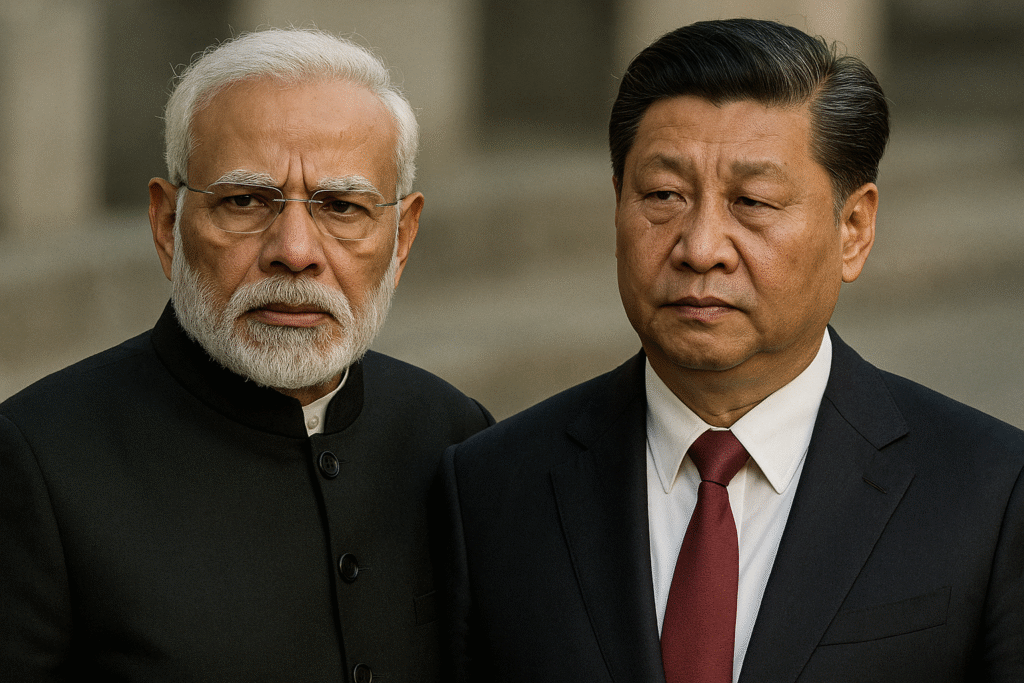
US Intelligence Report: India Sees China as Main Rival, Pakistan Focused on Tactical Nukes
A recent assessment by the U.S. Defense Intelligence Agency (DIA) has revealed critical insights into South Asia’s evolving security dynamics. The report highlights that India identifies China as its primary strategic rival, while Pakistan views India as an existential threat, continuing its focus on tactical nuclear weapons to offset New Delhi’s conventional military edge.
According to DIA Director Lt. Gen. Jeffrey Kruse, India treats Pakistan as a secondary challenge—“an ancillary security issue to be managed”—despite the recent military exchanges triggered by India’s targeted airstrikes on terror camps in Pakistan-occupied territories under Operation Sindoor, launched on May 7 in retaliation for the Pahalgam attack that killed 26 civilians.
India-Pakistan Military Clashes: May 7–10
The strikes led to four days of intense cross-border confrontation involving drones, missile systems, and heavy artillery. The clashes ended on May 10 with both nations agreeing to a temporary ceasefire. DIA’s assessment, presented to the U.S. House Armed Services Subcommittee on May 11, confirmed that Indian and Pakistani militaries agreed to halt hostilities after multiple waves of combat.
Pakistan’s Tactical Nuclear Focus
The report warns that Pakistan continues to invest in battlefield nuclear weapons to counterbalance India’s superior conventional forces. It also states that Pakistan remains heavily reliant on Chinese military support, including advanced combat aircraft like the JF-17 and J-10C and the PL-15 air-to-air missile, which were reportedly used during the recent hostilities.
The agency also notes that Pakistan is likely sourcing materials for its weapons of mass destruction (WMD) programs from suppliers in China, Hong Kong, Singapore, Turkey, and the UAE. This effort underscores Islamabad’s determination to modernize its nuclear arsenal amidst growing tensions.
India’s Strategic Priorities: Countering China, Military Modernisation
Meanwhile, the assessment emphasizes that India’s defense policy will increasingly focus on countering China’s assertiveness, especially along the Line of Actual Control (LAC), where skirmishes can escalate rapidly. While India and China agreed in October to disengage forces from two key friction points, the underlying border dispute remains unresolved, and the region remains volatile.
To project leadership and strengthen regional influence, India is expanding bilateral defense partnerships in the Indian Ocean region through military exercises, weapons trade, and intelligence collaboration.
Indigenous Defense and the Russia Factor
India is also pushing its “Make in India” initiative to boost domestic defense production and reduce dependence on foreign supply chains. In 2024, India commissioned its second nuclear-powered submarine and tested advanced missile systems like the Agni-I Prime and Agni-V, reinforcing its strategic deterrence capabilities.
Despite its growing defense ties with the West, India continues to maintain a working relationship with Russia, viewing it as essential for its economic and defense ambitions. While purchases of Russian arms have decreased, India still relies on Russian parts and maintenance support for its legacy fleet of tanks and aircraft.